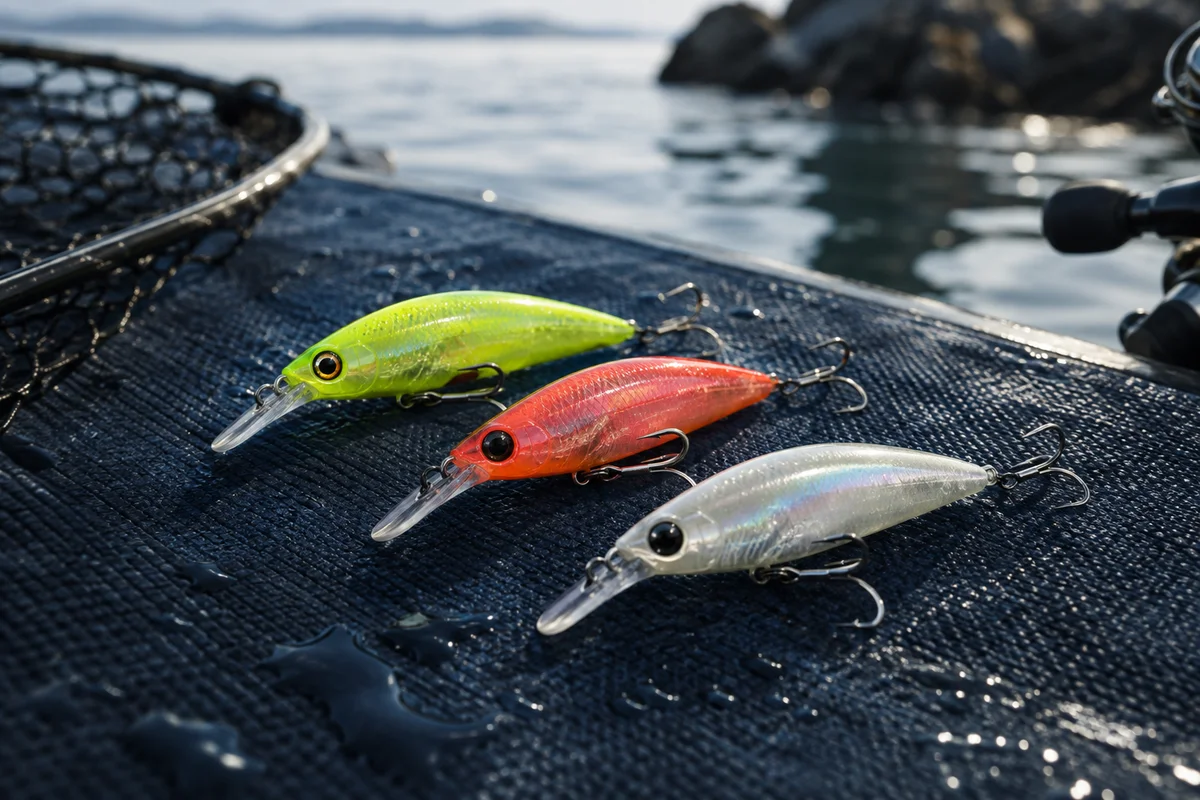
Do UV lures work? What the optics actually says
Trout, salmon and carp do have a fourth cone for ultraviolet. Whether a UV-painted lure is worth buying is a different question, and the water answers it.
The tackle industry sells a lot of UV. The premise is real: several important species — trout, salmon, carp, roach, tilapia — carry a fourth cone class peaking between 355 and 380 nm, in the near ultraviolet. They see a band of light you do not.
The part that is true
Carp is one of very few fish whose colour vision has been demonstrated behaviourally rather than inferred from pigment measurements: Neumeyer (1992) showed it genuinely uses four independent channels. Rainbow trout lose their UV cones as juveniles and regain them at maturity. This is not marketing; it is well-established visual ecology.
The part the packaging leaves out
Ultraviolet is attenuated harder than blue in every natural water there is, and dissolved organic matter absorbs it ferociously. In a tannin-stained lake, UV is effectively gone within centimetres of the surface. A "UV-bright" lure at three metres in a bog lake is not doing what the packet implies, because there is no ultraviolet down there for it to be bright in.
UV is a shallow, clear-water phenomenon. If you can see the bottom and the fish is a salmonid or a cyprinid, the claim has physics behind it. In coloured water at depth, it does not.
What a phone screen cannot do
An RGB display cannot emit ultraviolet. Any app — including this one — that shows you "what the UV channel looks like" is showing you a false colour it chose. We map UV onto a violet-magenta cast and label it as a declared fiction every single time it appears, because the alternative is letting people believe they are seeing something no screen can produce.
There is a second, subtler point. Our model computes on a 400–700 nm grid, so even the UV cone’s response is calculated only from the part of its sensitivity above 400 nm. For a cone peaking at 360 nm that is a minority of its total sensitivity. We report that fraction on the species page rather than quietly pretending the grid covers it.
Fluorescence is the more useful idea
What often gets sold as "UV" is really fluorescence, and fluorescence is genuinely powerful underwater. A fluorescent pigment absorbs short wavelengths and re-emits them 30–60 nm longer, so its effective reflectance can exceed 1 — more light leaves the surface in the emission band than arrives in it.
That matters because it is fed by exactly the light that survives at depth. In green coastal water the surviving band is 520–570 nm; a chartreuse pigment absorbing there and emitting at 560–580 nm is being handed free photons in the one part of the spectrum still available. That is the real reason chartreuse holds up in stained water, and it is a reason no static colour chart can express, because a chart has no illuminant.
Honest caveat: we have no spectrofluorimetry of commercial lure paint. The quantum yield in our model is a declared assumption in the middle of the plausible range for organic fluorophores, not a measurement. It is listed among the model’s least certain numbers.