Why red disappears underwater — and when it does not
Red is the first colour water eats in clear seas. In a tannin-stained lake the order reverses and red travels furthest. Here is the physics, with the numbers.
Anyone who has snorkelled knows the party trick: cut yourself at ten metres and the blood runs green. Red light is gone. It is the one piece of underwater optics that has escaped into general knowledge, and almost every fishing article repeats it as a rule.
It is a rule about one kind of water. In another, extremely common kind, it is exactly backwards — and if you fish lakes, that second kind is probably the water you are standing in.
What is actually happening
Water absorbs light, and it absorbs long wavelengths far harder than short ones. Pure water at 700 nm (deep red) absorbs about 0.62 per metre; at 470 nm (blue) it absorbs about 0.011 per metre. That is a factor of nearly sixty. Ten metres down in clear ocean water, roughly 2 % of the surface blue is left and essentially none of the red.
The relationship is exponential, which is why it feels so abrupt. Halve the survival every 1.1 m and after five halvings there is 3 % left; after ten there is 0.1 %. Red does not fade gradually. It falls off a cliff.
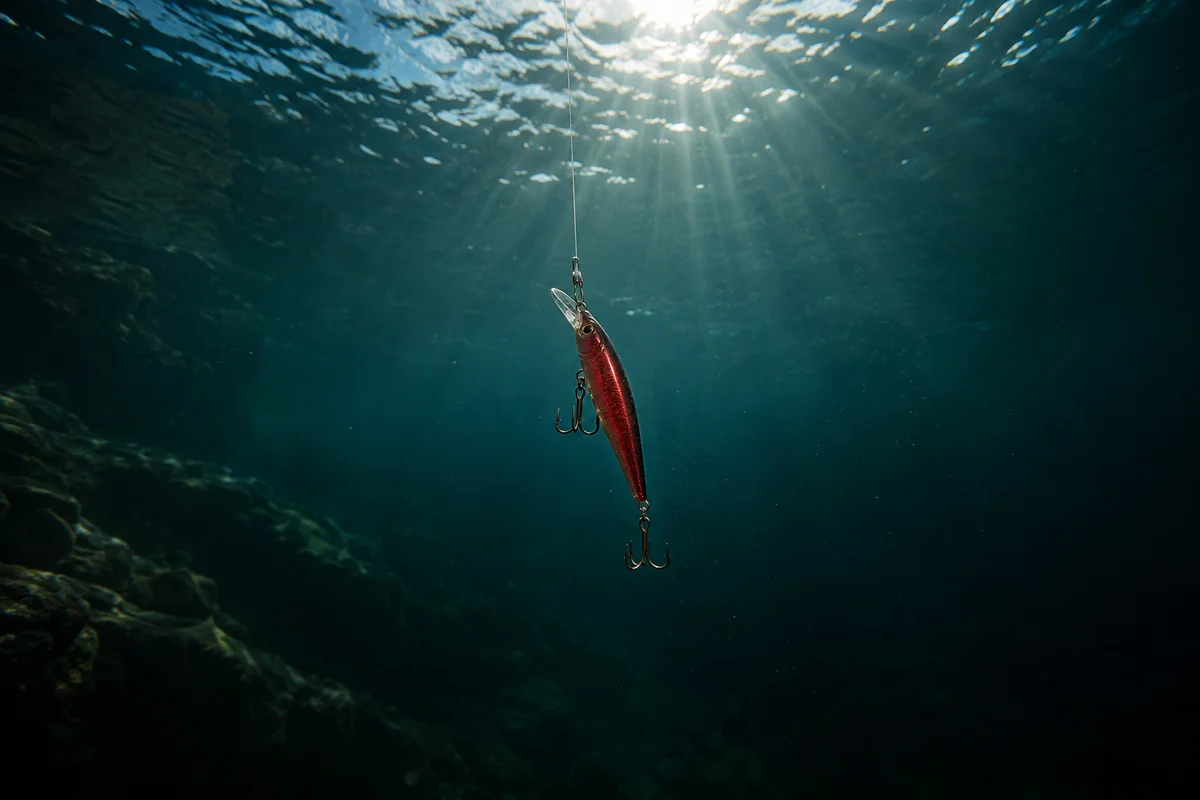
A red lure at 10 m in clear water is not "dark red". It is the same colour as the water behind it, which is to say invisible — not because the fish cannot see red, but because there is no red down there to reflect.
Now put tannin in the water
A lake fed by peat, leaf litter or conifer forest carries dissolved organic matter — the stuff that makes water the colour of tea. It absorbs almost exponentially with wavelength, and it absorbs hardest at the SHORT end. In a strongly stained lake, blue light is gone within centimetres.
So the transmission window moves. In the clearest ocean water the best-penetrating wavelength is around 470 nm. In our tannic freshwater preset it sits above 620 nm — in the orange-red. That is not a modelling artefact; it is why blackwater looks like tea rather than like ink.
- Clear ocean (Jerlov I): best transmission ≈ 470 nm — blue wins.
- Turbid coastal water (Jerlov 9C): ≈ 550 nm — green wins, and blue is now attenuated worse than green.
- Tannin-stained lake: > 620 nm — red and orange win outright.
The half that every chart leaves out
Knowing which colours survive is only half the problem. The other half is what the lure is seen against — and murky water does not just block light, it glows. Suspended particles scatter light back toward the viewer, and that backscattered haze sits between the fish and your lure like fog lit from within.
This is Duntley’s law: apparent contrast falls as C(r) = C₀·e^(−c·r), where c is the beam attenuation coefficient and r is the viewing distance. It is why a lure can be perfectly bright and still be invisible at two metres. Every "lure colour at depth" chart on the internet models the light going down and none of them model the haze coming back, which is why they all overstate how far away a lure can be seen.
What to actually do with this
- In clear water past about 5 m, a red lure is a dark lure. If you want dark, that is fine — say so on purpose.
- In stained or tannic water, red and orange are among the LAST colours to go, not the first.
- In muddy water the limiting factor is not colour at all: the water is bright and opaque, and the useful contrast is brightness, not hue.
- Looking up at a lure against the surface, colour barely matters. A silhouette is a silhouette. Profile and darkness are what you are choosing.
None of this predicts a strike. It predicts whether the fish can tell your lure apart from the water, which is a necessary condition for a strike and not a sufficient one.